
Non-Disclosure Agreement
The following materials contain confidential and proprietary information belonging to ForLife Global Ltd. To continue, please review and accept the terms below. Access is granted solely for the purpose of evaluating a potential investment or partnership.
By accepting, the recipient agrees to be bound by the ForLife Global Ltd Non-Disclosure & Intellectual Property Protection Agreement, including:
- Confidentiality. All information disclosed is confidential and must be protected, not copied, and not shared with third parties without written consent.
- Intellectual property. All IP, technology, designs and concepts remain the sole property of ForLife; no rights or licences are granted.
- No AI training or scraping. The materials may not be used to train AI models, data-mine or scrape.
- Non-compete & non-circumvention. The recipient will not use this information to build competing products or to bypass ForLife with its partners or clients.
- Non-solicitation. No soliciting of ForLife's employees, contractors, clients or partners.
- Confidentiality of discussions. The existence and content of these talks and any negotiations stay private; ForLife's name or brand may not be used without written consent.
- Binding on access. Opening these materials constitutes acceptance, and the confidentiality & IP obligations survive indefinitely.
This summary is for convenience only. The full executed ForLife Global Ltd NDA governs and takes precedence. Governing law: United Kingdom / Australia / Thailand as applicable.
Health data today is fragmented — and everyone pays for it
Healthcare data was built in silos. The result is risk, cost, and care that arrives late.
Data scattered across clinics, labs and systems — inaccessible to the patient who owns it.
Centralised databases are high-value targets; millions of records are compromised every year.
Manual, cross-provider handoffs delay care, duplicate tests and drive avoidable cost.
Existing tools rarely turn a person's data into real-time, personalised guidance.
The conditions for a health-data standard are finally here
National health exchanges are live and standards-driven — but they still lack a patient-owned consent and portability layer.
After a decade of breaches, patients and regulators now demand privacy, provenance and control by default.
Unified, structured records unlock real-time insight, prevention and population-health analytics at last.
You already have the right to your records
The law increasingly guarantees patients access to their own data — and forces providers to hand it over. ForLife is the tool that exercises that right.
In the EU and UK, GDPR gives every person the right to a machine-readable copy of their health data, on demand.
The US Cures Act bans information-blocking and requires providers to expose standardised FHIR patient-access APIs — the exact rails ForLife runs on.
Where no API exists yet, the law still compels disclosure. ForLife issues the request — a tap to ask, a tap to approve.
ACCESS REQUEST
Neutral infrastructure that puts patients in control
Health data stays with the clinics and the people who own it. ForLife manages the identity, permissions and immutable audit trail that make it trustworthy and portable.
Blockchain-secured identity and granular, revocable permissions. The patient decides who sees what, and for how long.
Predictive risk, early detection and a personal health assistant turn raw records into real-time, actionable guidance.
FHIR R4 APIs connect EHRs, insurers, wearables and national exchanges — no rip-and-replace, no lock-in.
Hybrid blockchain — your data never sits on-chain
Role-based apps & dashboards, mobile and desktop.
AES-256 records with configurable data residency. The data never leaves its jurisdiction.
Periodic tamper-proof anchoring. No user tokens or wallets required.
Two angles, pursued deliberately
Not a single rollout — a strategic push for consumer traction, and a separate tactical foothold for institutional proof.
The wedge that wins real user volume — launched in Sydney, New York, Berlin and Bangkok, where the card spreads fastest.
A separate, deliberate play for a licensing relationship with a sophisticated national health system — proving the enterprise model in parallel.
ForLife Verified: the feature that gets everyone in the door
ForLife VerifiedResults flow straight from accredited partner clinics and labs. Trust is built in.
Show in person like a boarding pass, or send an auto-expiring link. Revoke anytime.
Incognito mode and fully anonymous verification — partners confirm status without tracking identity.
Dating & lifestyle app integrations and white-label clinic cards turn every share into an invite.
A flywheel that compounds with every user
Consumer virality feeds institutional value, and institutional value funds more consumer growth. The network gets more useful — and cheaper to grow — at every turn.
Where the card launches first
Launch the consumer wedge where it spreads fastest — open culture, digital dating, normalised testing. The UAE runs on a separate, institutional track.
One platform, five stakeholders
Every role has a live, purpose-built dashboard — and every new participant compounds the value of the network.
Own, carry and share records. AI health assistant & digital passport.
Instant, permissioned access. Vitals, notes, scheduling and telehealth.
Instant verification, automated claims and blockchain-backed fraud detection.
Population-health metrics, compliance monitoring and blockchain verification.
Consent-based, anonymised data and open APIs for approved innovation.
For patients: real control, real features


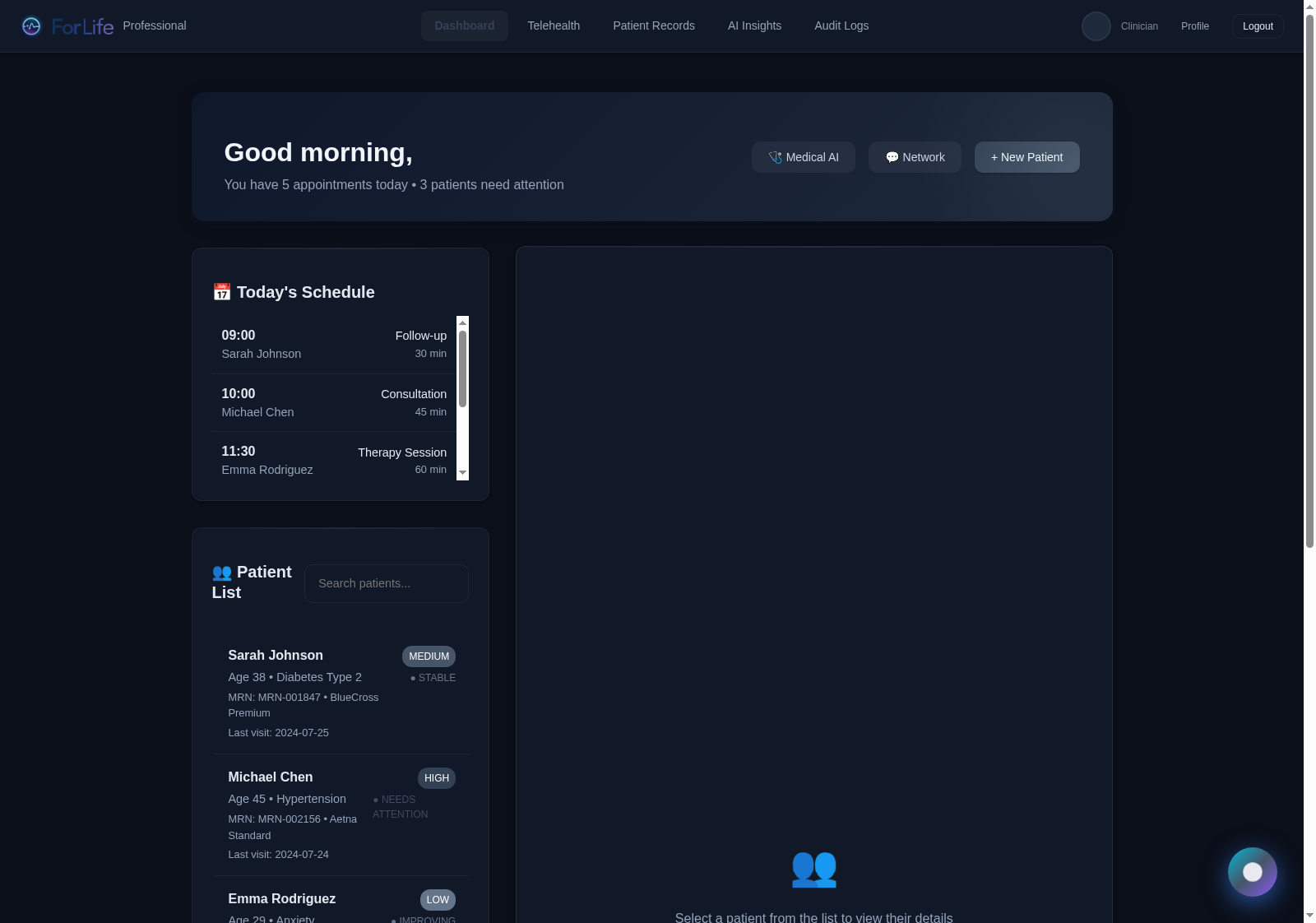
For clinicians: every patient, at a glance
High, medium and low-priority patients surfaced instantly — no digging.
Insurer, MRN, condition and history in a single pane — no switching systems.
Schedule, consult and document without leaving the platform.
For governments: national oversight, in real time
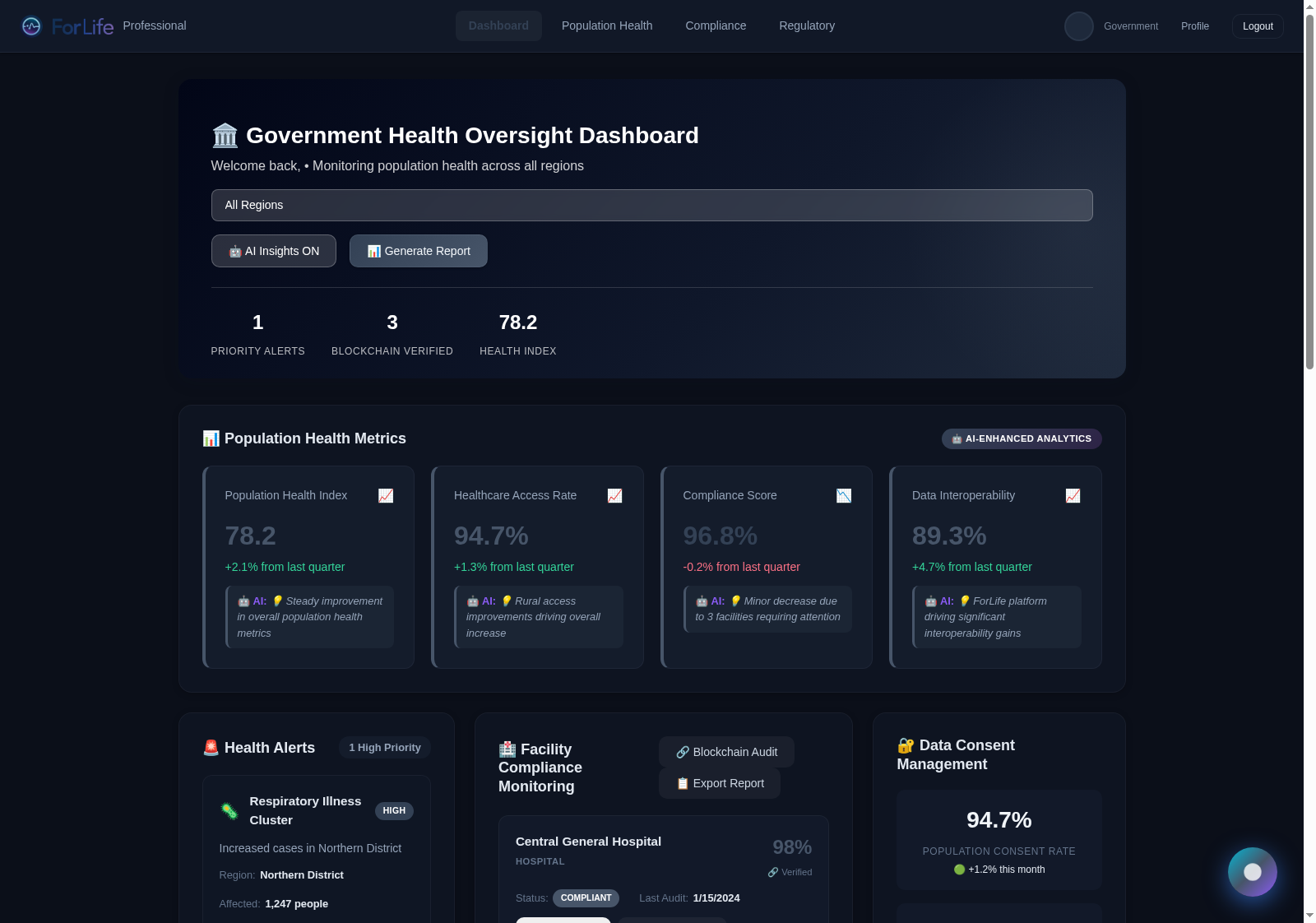
A live health index and access-rate view across every region, not just a facility.
Facility audits and consent rates that regulators can trust, not just trust us on.
Outbreak and risk alerts surface before they become a crisis.
For insurers: claims and fraud, automated
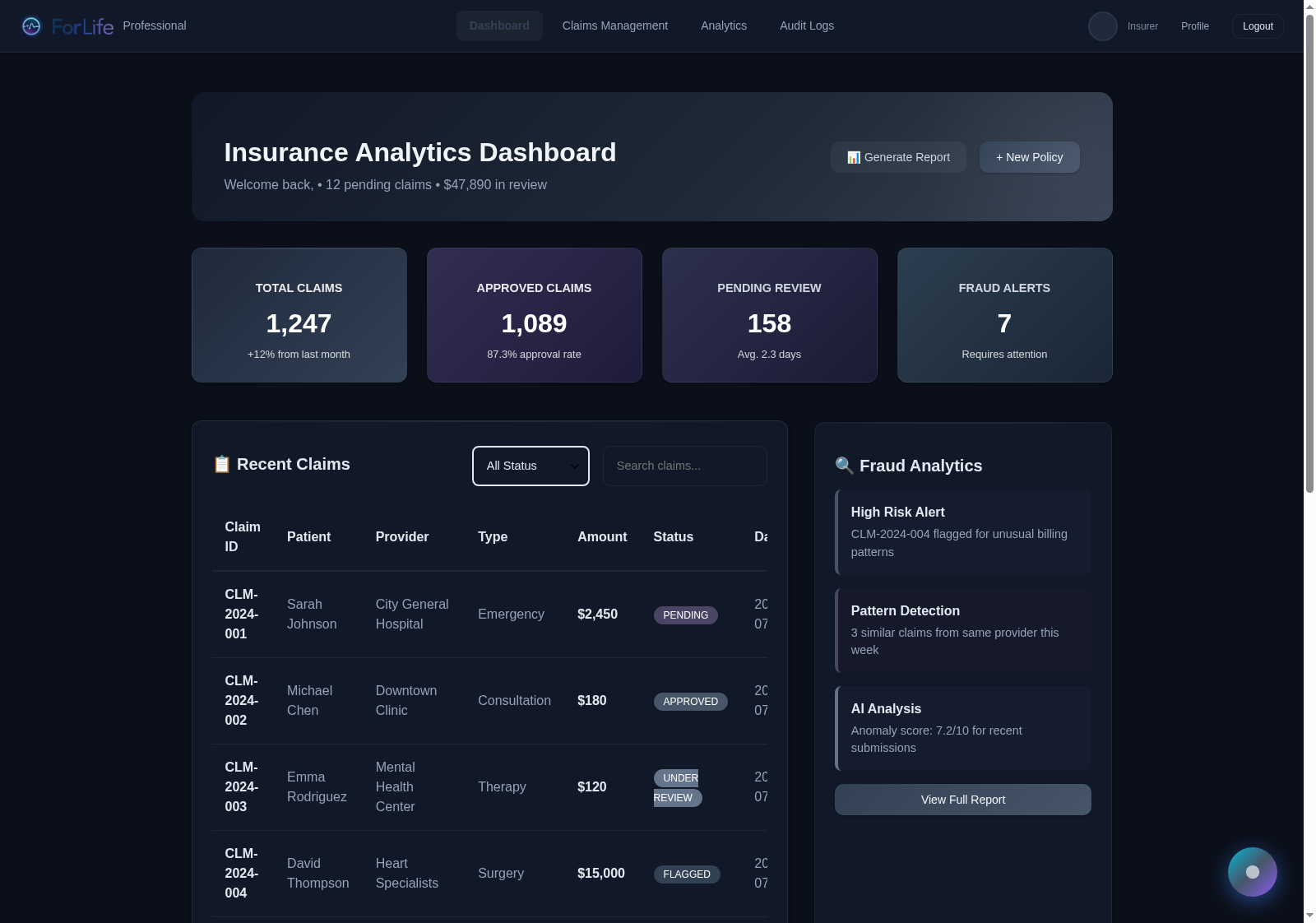
Volume, approvals and pending review tracked live, no manual reporting.
Unusual billing patterns and provider anomalies flagged automatically.
Instant eligibility checks replace slow, manual back-and-forth.
Under the hood: built to run at scale
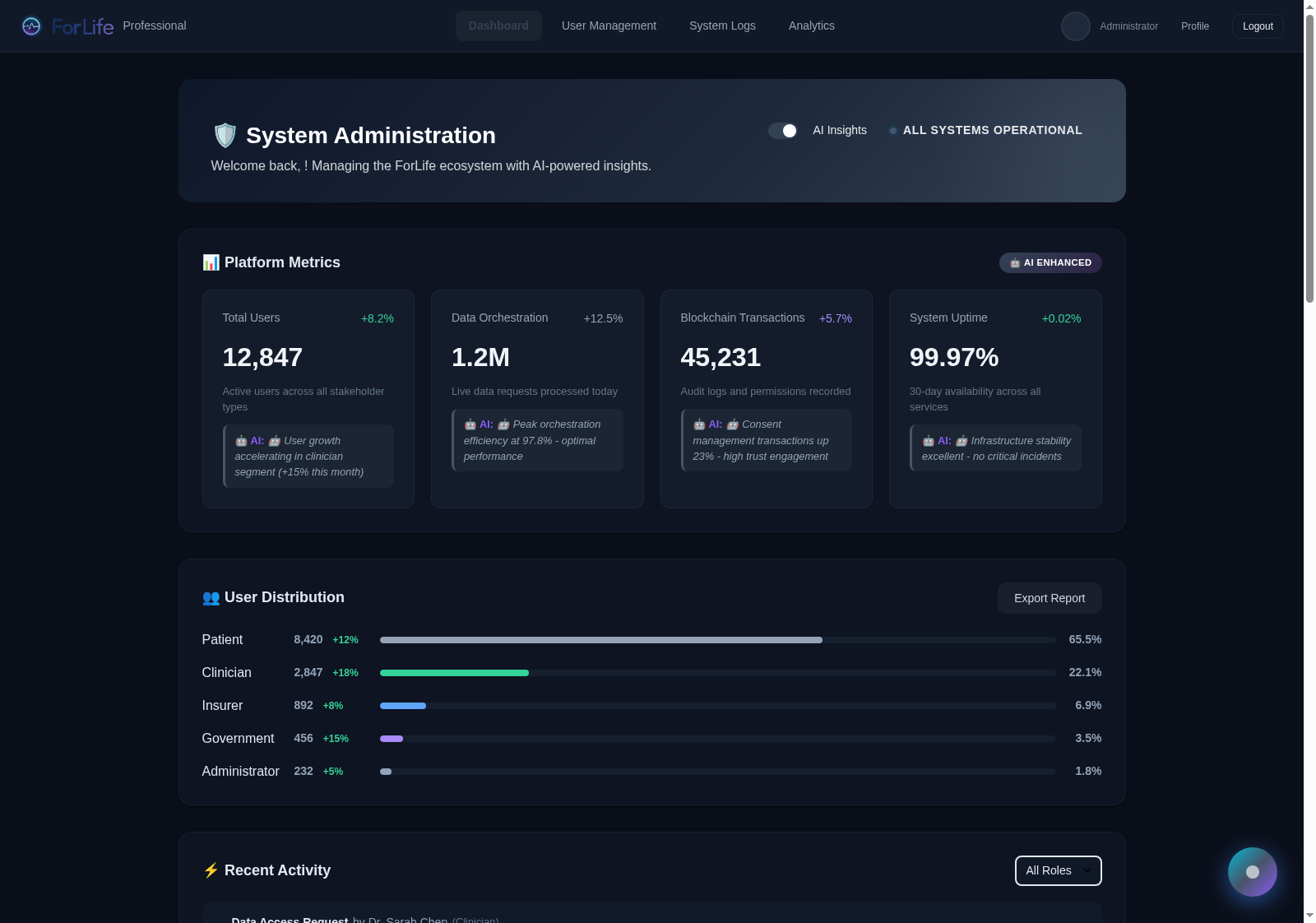
Users, data throughput and blockchain transactions, monitored in real time.
Every role, every access, logged and reportable on demand.
Built for the reliability a national health system requires.
Where this could go, over the long term
Not a near-term plan — the direction we're building toward if the wedge and institutional tracks both land.
The Verified card drives low-cost downloads and daily engagement in early markets.
Clinics, hospitals and insurers adopt ForLife as a verification and records layer.
If adoption compounds, device-maker and government partnerships become a realistic conversation — not a promise we're making today.
Everything ForLife does
Six capability pillars — one platform. The card is the doorway; this is the house.
Built for your pocket — and for the moment it matters most
Smart reminders keep medications, vaccinations and check-ups on schedule — the difference between catching something early and catching it too late.
Schedule with any connected clinic in a single tap — synced straight to your record, with no hold music and no missed follow-ups.
One tap shows any medic your allergies, conditions, medications, blood type and insurance — offline and instant. The modern dog tag, for when seconds decide the outcome.
Clinicians can break the glass to save your life — and every access is logged immutably, so care never costs you your privacy.
AI that turns years of results into one clear picture
Blood panels, labs, scans, vitals and wearables — all pulled into one timeline.
It catches the slow drift across years that any single test would miss.
Surfaces the risk and what to check — before a symptom ever shows up.
Turns raw numbers into "here's what's happening, and here's what to do".
Features that sell themselves
Every one is a reason to download — and a reason to never delete.
How ForLife optimises the whole system
Eligibility, prior authorisation and billing move from manual queues to automated smart contracts.
Risk scoring moves budget from costly late-stage treatment to low-cost early intervention.
A record that follows the patient ends the repeat scans and labs ordered "just in case".
Permissioned access ends faxing and chasing records — clinicians see the whole story, instantly.
The inefficiency we remove
Verification, claims and paperwork ForLife automates end to end.
The costliest sector for breaches. Decentralised, ForLife removes the target.
Replacing the dozens of disconnected systems a person's data lives in today.
Billions saved across the system, every year
The record follows the patient, so nothing is re-ordered "just in case".
Smart-contract billing and instant verification replace weeks of paperwork.
AI triage and telehealth resolve the routine before it books a slot.
Allergy and drug-interaction alerts stop costly, avoidable harm.
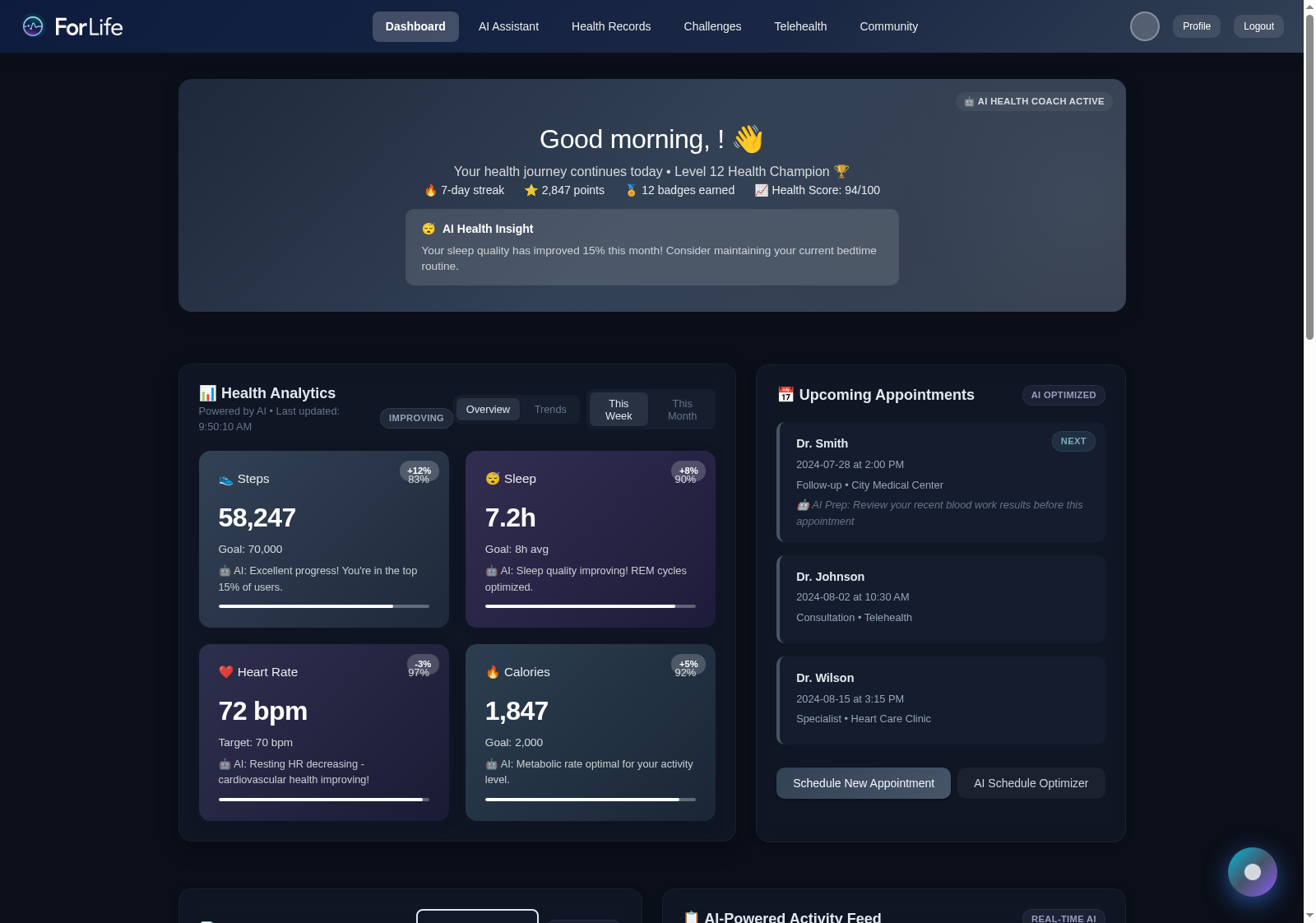
Not a concept — a working platform
Compliance and security, by design
AES-256 today, migrating to NIST post-quantum standards — health data stays secret for decades.
Passkeys (FIDO2) and biometrics replace weak SMS codes. Never trust, always verify.
Data stays encrypted even while processed, inside secure enclaves — so AI runs without exposing records.
Prove “clear” or “insured & eligible” without revealing the underlying data.
Every access logged on-chain; data residency configurable per jurisdiction — sovereign by design.
Real-time anomaly detection, automated incident response, and instant consent revocation.
Why the UAE leads the institutional track
This is the enterprise side only — the consumer Verified card launches separately, in Bangkok, New York and Sub-Saharan Africa.
Win the UAE and you win a template — plus the ties into the wider GCC, MENA, Africa and South Asia. As a global medical-tourism hub, millions of visitors carry the credential home.
A single national mandate can drive adoption across the whole system — versus fragmenting through payer-by-payer sales elsewhere.
Strict residency rules that lock out foreign big-tech are exactly what ForLife satisfies by design. Their barrier is our advantage.
The UAE wants to be the world's most advanced, AI-first digital-health state — and regulatory sandboxes (DIFC, ADGM, Dubai Health) let us pilot fast with legal cover.
Why can't the giants just do this instead?
They own the provider-side record — and profit from keeping it locked to their system. Giving patients true, portable ownership undermines their own switching costs.
They have the devices, not the clinical trust or regulatory depth — and touching sensitive health data directly cuts against their privacy positioning.
Single-purpose tools solve one slice — verification, or tracking, or telehealth — never the full patient-owned, cross-institutional layer.
Mandated patient-access APIs and cross-border data-residency law are new — the regulatory floor this depends on didn't exist when incumbent strategies were set.
Go-to-market, step by step
Not a global launch on day one — a specific, sequenced path from first clinic to national scale.
One anchor clinic in one launch metro — the physical onboarding kit goes live there first.
Patients onboard at the point of care and start using the Verified card day one.
One insurer partner connects for verification & claims, proving the institutional side.
Repeat the proven clinic-city-insurer pattern in new metros, then pursue the UAE institutional pilot.
Growth built into the clinic
Our cheapest, highest-intent channel isn't an ad — it's the clinic itself. Patients onboard at the point of care, when trust is highest.
Clinics contract with ForLife before launch — demand is booked before the platform ships.
Window decals, waiting-room posters, reception and exam-room QR codes turn every clinic into an acquisition surface.
Patients scan and join during a visit — highest trust, highest intent, near-zero acquisition cost.
A $500B market, entered through a sharp wedge
Five ways ForLife earns
A diversified model spanning consumer and institution — resilient, recurring, and privacy-preserving.
Clinics, hospitals, insurers and governments license ForLife as their verification, records and audit layer. High-value, recurring, and sticky.
Per-verification and data-sharing fees from the Verified card and insurance checks.
Freemium to premium — advanced AI insight, analytics and wearable integration.
Device-maker partnerships to ship ForLife as the default health ID.
Opt-in, anonymised data for research — privacy preserved, users in control.
Why ForLife wins — and stays won
Patents filed on blockchain data-sharing, the AI insights engine and the integration mechanism.
Every user, clinic and institution makes the platform harder to displace.
Multi-jurisdiction compliance built in from day one — years ahead of new entrants.
Path to $100M in five years
Revenue climbs as the mix shifts from consumer fees to high-margin institutional licensing and opt-in data.
The hard parts, named honestly
We've identified the real risks to this plan. Here's what they are, and how we're built to handle them.
Our approach: pre-signed pipeline before launch, plus a low-friction physical onboarding kit that shortens time-to-value per clinic.
Our approach: configurable data residency built in from day one, and a single launch market first rather than parallel jurisdictions.
Our approach: the wedge is paired with real point-of-care distribution, not organic growth alone — success doesn't depend on going viral.
Our approach: FHIR-standard APIs designed for existing EHRs, so we integrate alongside legacy systems rather than requiring replacement.
Raising $2M to win the beachhead
What the raise unlocks in 12 months
Clear, sequenced milestones — each one de-risks the round and sets up Series A.
A capital-efficient path to a real return
Innovate UK, Horizon Europe and health-innovation funds across Australia and the Gulf can fund milestones without dilution — extending every dollar of this round.
A natural target for EHR majors, insurers, telecoms or big-tech health arms seeking the patient-consent layer they lack.
As ForLife becomes the standard across multiple national systems, public-market scale becomes the path.
Network effects and switching costs make each year of adoption worth more than the last.
Founder-led, built for scale
A multidisciplinary team spanning technology, healthcare and public health.
Secure, decentralised systems built for global scale.
Predictive analytics and personalised health insight.
Bridging national databases, clinics and wearables.
Strategy on compliance, partnerships and scale.
An advisory board across healthcare, compliance and technology is being assembled as we scale.